Accessible documents
Accessible PDFs – fixed automatically, verified with the tools auditors use.
DokAudit finds the PDFs on your website, checks them against PDF/UA-1 and WCAG 2.2, repairs what can be repaired safely and proves the result with a report. Built for organisations that publish hundreds of documents and cannot fix each one by hand.
- PDF/UA-1 validated with veraPDF
- PDF/A-2a in the same file
- Hosted in Germany (ISO/IEC 27001)
- from €0.50 per page
Try it free – 100 pages · Talk to us
Why PDFs are the weak spot
Many organisations have rebuilt their websites to be accessible. The documents behind them – forms, reports, policies, contracts, minutes – usually are not. For a screen reader they are often just an unordered stream of characters.
Since 28 June 2025 the European Accessibility Act (Directive (EU) 2019/882) applies to many products and services sold in the EU, from banking and e-commerce to transport and e-books. Public bodies have been covered by the Web Accessibility Directive (EU) 2016/2102 for years. Both point to EN 301 549, which builds on WCAG – and for PDFs, PDF/UA (ISO 14289) is the technical standard that makes it testable.
How it works
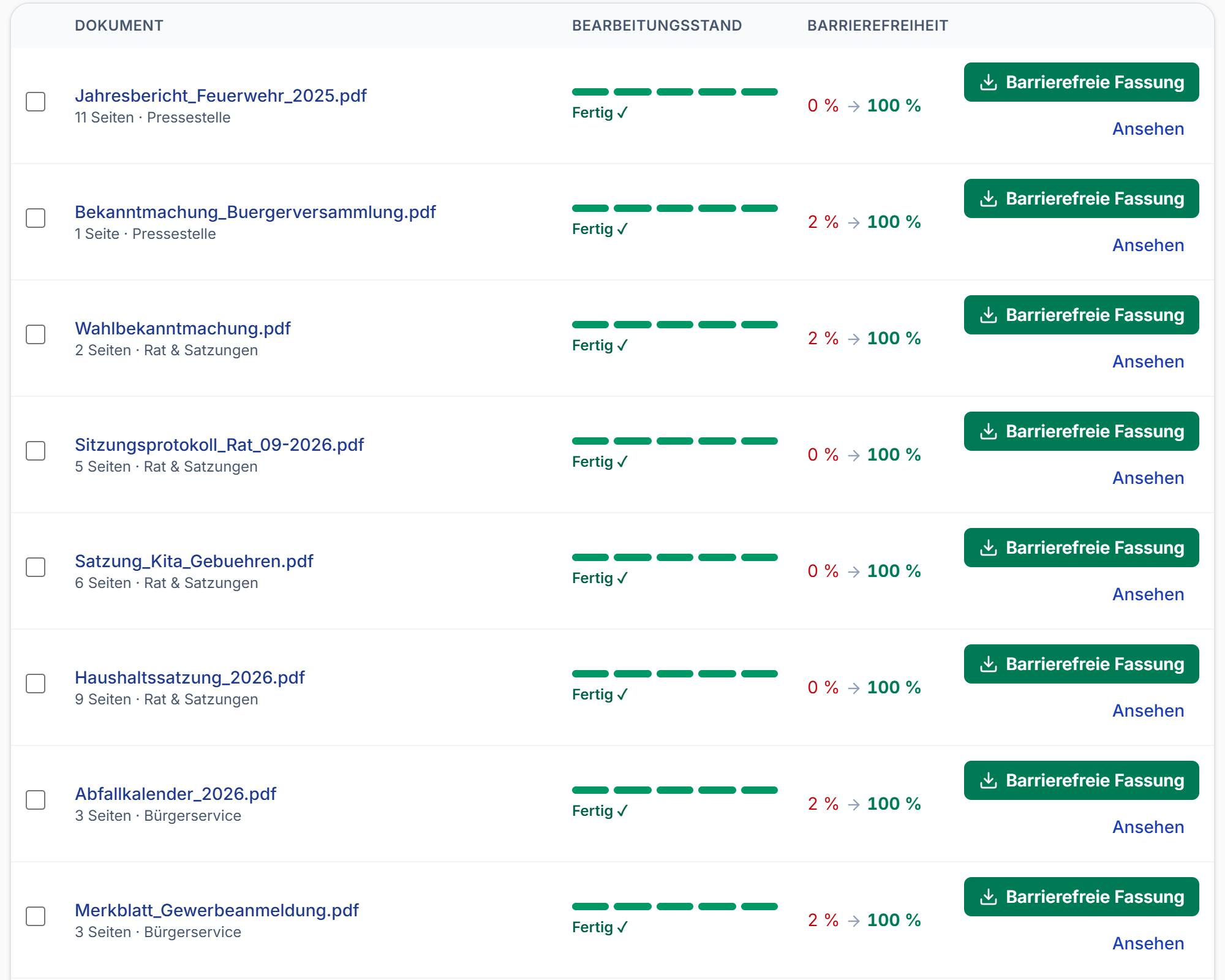
- Find: Enter your website address. DokAudit crawls it, finds every linked PDF and scores each document – free, without an account.
- Fix: Upload or connect your CMS. DokAudit repairs structure, reading order, tables, fonts, form fields and language, and drafts alternative text where needed.
- Prove: Every change is re-measured until no findings remain. You get the fixed file plus a report for your accessibility statement.
How DokAudit works in detail
Measured, not claimed
DokAudit does not stop at its own score. Each file is validated with the reference tools of the PDF industry.
- PDF/UA-1 with veraPDF: The open-source reference validator of the PDF Association checks every file against ISO 14289-1.
- WCAG 2.2 and colour contrast: The machine-testable WCAG 2.2 criteria plus contrast measured on the rendered page.
- Matterhorn checkpoints: A second, independent check of the conditions that PAC reports – headings, tables, lists, fonts, marked content.
- PDF/A-2a for the archive: On request one file meets PDF/UA-1 and PDF/A-2a at the same time – one document for the website and the records system.
- AI only where rules are not enough: Alt text and complex layouts. Every AI result is re-validated; AI can be limited to EU providers or switched off.
- Honest about limits: Whether an alt text really explains a chart is a human judgement. The report says so instead of hiding it.
Proof you can file
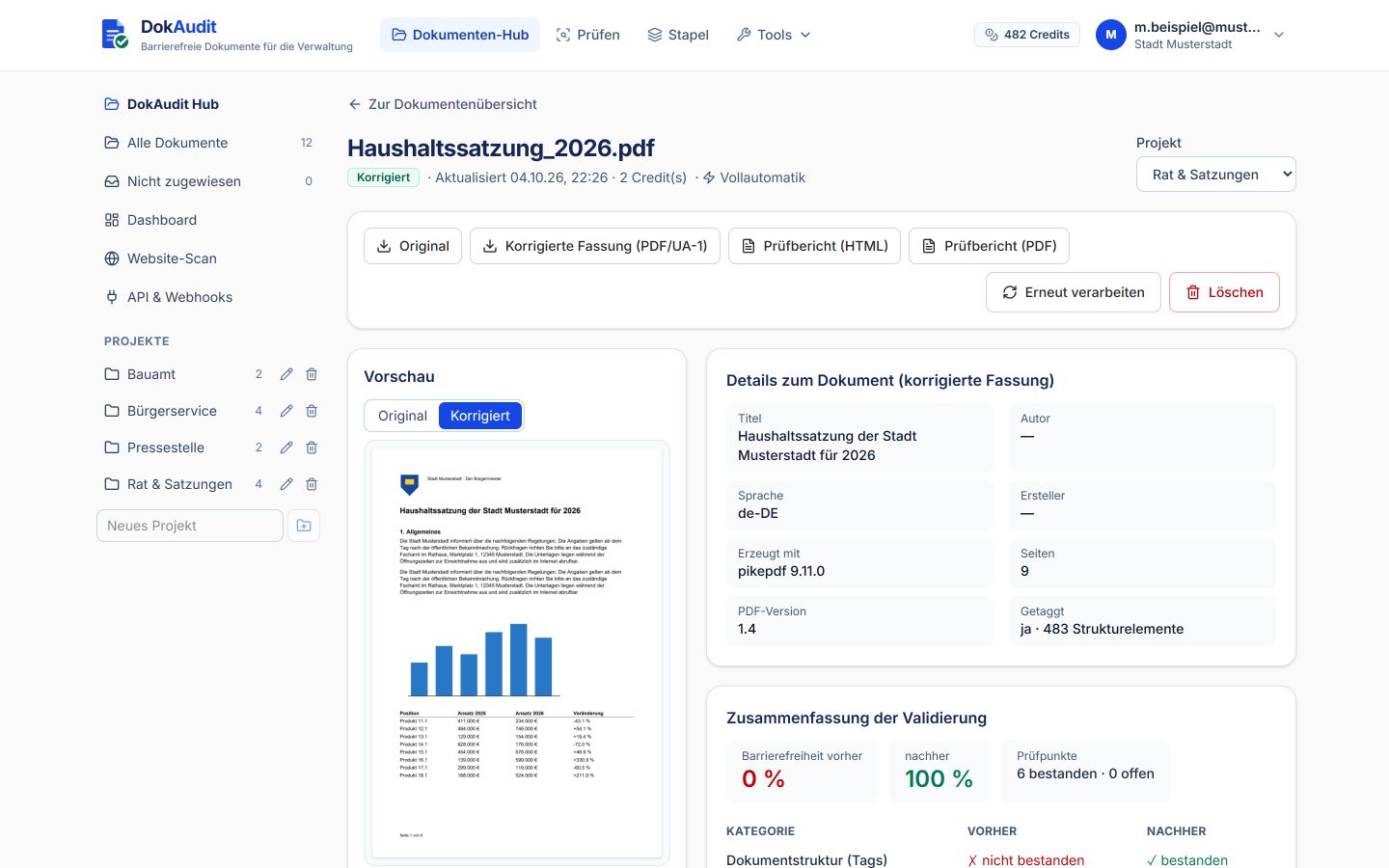
Every document gets an accessible test report: overall result, the checks in a PAC-style grid, the repairs made and the remaining points, if any. A municipal budget of 1,181 pages went from more than 240,000 PDF/UA violations to zero – without manual work.
- Before/after score per document
- Report itself tagged and accessible
- Ready for your accessibility statement
Questions
- Does this replace a full accessibility audit?
- It replaces the expensive routine work: finding and fixing the typical PDF defects. A full conformance assessment also needs human checks; the report gives you the groundwork and the evidence.
- Which languages does DokAudit handle?
- The web app and the test report are currently in German; an English interface is in preparation. The remediated PDFs, the API and the CMS plugins work for documents in any language – English, French, German, Italian and Spanish are detected automatically.
- Where is my data processed?
- On servers in Germany (ISO/IEC 27001). Uploaded documents are deleted after 7 days. On-premises operation is available for larger organisations.
- What about the UK?
- UK public sector bodies follow the Public Sector Bodies Accessibility Regulations 2018, which also reference WCAG. The PDF/UA and WCAG checks apply in the same way.
See it on your own documents
Run a free website scan or test 100 pages free of charge. No credit card, unlimited users.
Start free trial · Pricing